Skin Health describes the current functional state of the skin: how effectively it performs its fundamental biological roles at a given moment.
Skin Longevity adds another dimension: time. It asks not only whether the skin functions well today, but how effectively those functions are preserved, restored and sustained over the years. This includes recovering from environmental or physiological stress, maintaining structural integrity, minimizing cumulative damage and retaining functional capacity under repeated daily challenges.
The goal is to support the biological processes that keep skin healthy and functional for longer.
The Five Scientific Domains of Healthy Skin Function
To translate these concepts into a practical framework for cosmetic science, five interconnected domains can be used to describe skin function and its preservation over time.
1. Barrier: Maintaining Protection, Hydration and Comfort
The skin barrier is the first line of defense against the external environment. It regulates water loss, protects against irritants and microorganisms, and contributes to overall skin comfort.
An effective barrier depends on an organized stratum corneum, an appropriate lipid composition and sufficient water retention.
Hydration is a fundamental component of this function, but it should not be considered an isolated measure of skin health. It is one measurable outcome of a broader barrier system.
Supporting barrier function means maintaining water balance, reducing excessive transepidermal water loss (TEWL) and preserving the skin’s protective capacity.
2. Balance: Supporting Biological Homeostasis
Healthy skin relies on a carefully regulated biological environment. This includes interactions between skin cells, the microbiome, immune responses and antioxidant defense mechanisms.
Environmental exposure, pollution, UV radiation and other stressors can disrupt this balance, contributing to oxidative stress, inflammatory responses and impaired skin function.
The goal is to help maintain homeostasis, support microbiome health and help manage oxidative stress and inflammatory responses.
3. Renewal: Supporting Natural Repair and Differentiation
The epidermis is continuously renewing itself through cellular proliferation, differentiation and desquamation. This process is essential for maintaining an organized epidermal structure and an effective skin barrier.
However, healthy renewal is not simply about accelerating cell turnover. It depends on the orderly progression of epidermal differentiation and the coordinated removal and replacement of skin cells.
Supporting natural renewal means promoting appropriate differentiation, desquamation and repair processes while maintaining epidermal integrity.
4. Structure: Preserving the Skin’s Extracellular Matrix
The structural properties of the skin depend heavily on the extracellular matrix (ECM), a complex network of proteins that provides mechanical support, firmness and elasticity. Collagen, elastin and fibronectin are essential components of this matrix.
Over time, intrinsic aging and environmental exposure can alter ECM organization, increase matrix degradation and reduce the skin’s structural resilience.
Preserving structure means supporting collagen homeostasis, maintaining elasticity and protecting the matrix from excessive degradation.
5. Resilience: Maintaining the Ability to Adapt and Recover
Skin is continuously exposed to environmental and physiological challenges. UV radiation, pollution, temperature changes, irritants and other exposome-related factors can compromise skin function through repeated stress.
Resilience describes the skin’s ability to tolerate these challenges, recover following disruption and maintain functional performance.
Importantly, resilience is not defined only by the absence of immediate damage. It also considers how effectively the skin recovers and whether its functional capacity is maintained following repeated exposure.
This domain is particularly relevant to Skin Longevity because it introduces the concept of cumulative stress and long-term functional preservation.
A Unified Framework: Protect → Renew → Sustain
Although the five scientific domains provide a comprehensive description of skin function, translating them into a clear cosmetic positioning requires a simpler structure. The Protect → Renew → Sustain framework brings the five domains together into three complementary pillars.
PROTECT Barrier + Balance Protect barrier function, hydration, comfort and biological balance. Water balance · Lipid protection · Homeostasis · Oxidative stress management
RENEW Renewal Support orderly differentiation, desquamation and natural repair. Epidermal renewal · Differentiation · Repair · Barrier recovery
SUSTAIN Structure + Resilience Preserve structural integrity, resilience and healthy skin function over time. ECM integrity · Collagen homeostasis · Elasticity · Stress recovery · Long-term preservation
This structure maintains the scientific breadth of the five domains while providing a simpler and more intuitive narrative for cosmetic product positioning.
It also addresses an important limitation of traditional skincare frameworks: hydration alone cannot adequately represent skin health or longevity.
From Scientific Concepts to Measurable Skin Benefits
For Skin Longevity to become more than a marketing concept, its underlying mechanisms must be connected to measurable outcomes. A technically defensible framework requires different levels of substantiation, depending on the biological function and the intended cosmetic claim.
At the mechanistic level, in vitro and ex vivo models can assess biomarkers such as collagen and elastin synthesis, MMP activity, differentiation markers, antioxidant capacity and inflammatory mediators. Instrumental methods then measure skin function directly: corneometry for hydration, TEWL for barrier integrity, cutometry for elasticity and imaging for skin surface and density.
Biological activity, however, must translate into meaningful skin benefits. Clinical assessments can demonstrate improvements in hydration, elasticity, firmness, visible wrinkles, skin comfort and recovery following controlled stress.
For Skin Longevity claims, repeated-use studies and longitudinal assessments become particularly relevant. They help determine whether improvements are maintained over time rather than representing only short-term cosmetic effects.
The distinction is important:
- Biomarkers explain biological mechanisms.
- Instrumental endpoints demonstrate skin function.
- Clinical outcomes demonstrate visible or consumer-relevant benefits.
Together, these approaches create a more robust foundation for substantiating Skin Longevity claims.
The Role of Cosmetic Ingredients in Skin Longevity
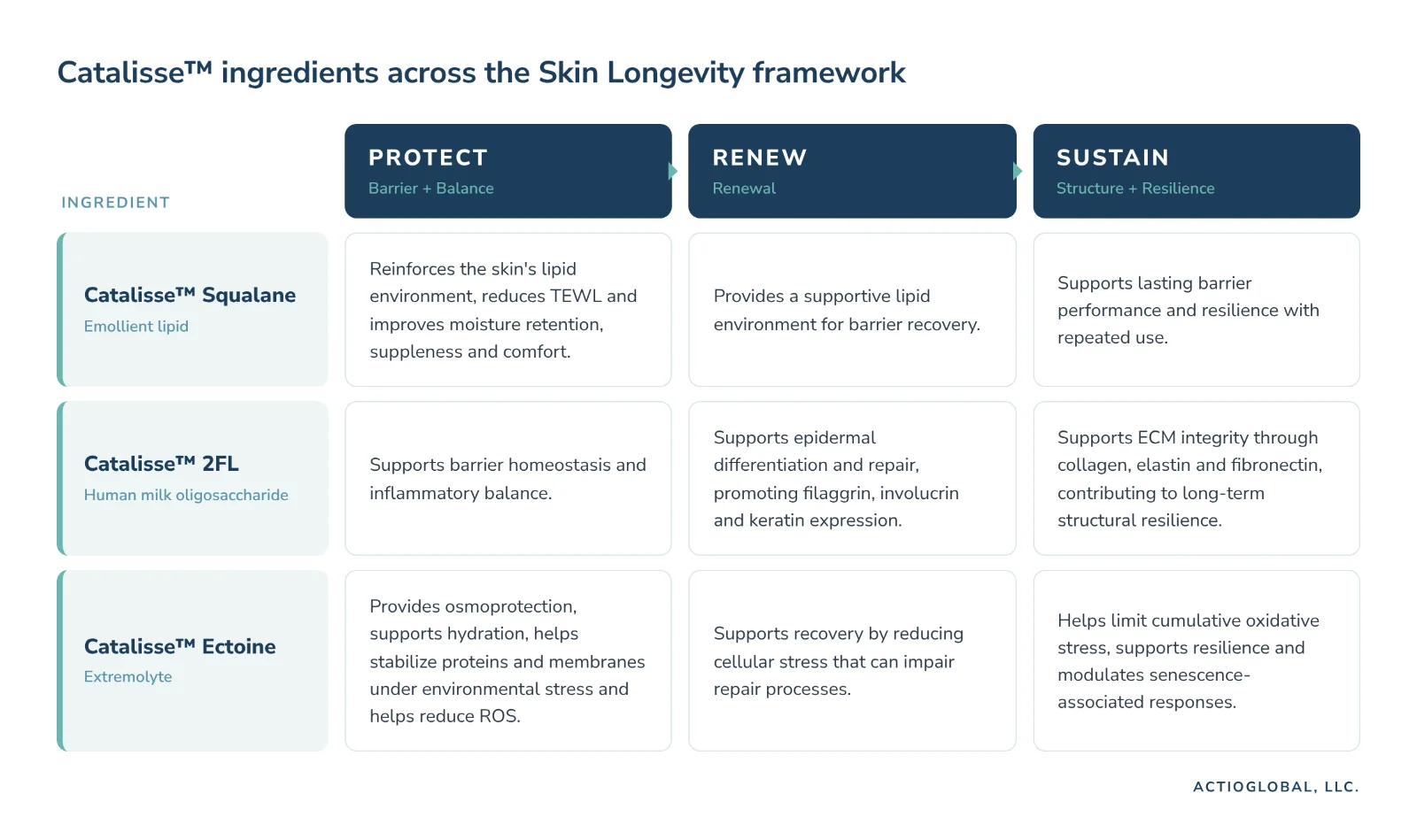
The Protect → Renew → Sustain framework also provides a way to understand how different cosmetic ingredients can contribute to multiple aspects of skin health. Rather than assigning an ingredient to a single benefit, it recognizes that different mechanisms may support several interconnected functions:
Moving Beyond Anti-Aging: A More Complete Definition of Healthy Skin
The evolution from traditional anti-aging concepts toward Skin Longevity represents a broader shift in how skin health is understood.
Instead of focusing exclusively on reducing wrinkles or improving hydration, this approach considers the interconnected biological systems responsible for maintaining healthy skin. It recognizes that skin health is dynamic: it changes in response to internal biological processes, environmental exposure and repeated daily stress.
Maintaining healthy skin therefore requires more than treating visible signs. It requires supporting the functions that protect it, renew it and sustain it over time.
Protect → Renew → Sustain offers a unified framework for translating this scientific perspective into cosmetic innovation. It connects established skin biology with measurable functional outcomes and creates a common language for ingredient development, formulation strategy, clinical testing and product positioning.
Ultimately, the next generation of skincare should not ask only how skin looks today. It should also ask how effectively skin can maintain its health, recover from challenges and preserve its function tomorrow.
Because Skin Longevity is not simply about looking younger. It is about maintaining healthy skin function for longer.